No serious‑injury demand should leave your office untested.
Before you engage us, know where we come from and why it changes every file we touch.
- Founder‑led
- No account layer. No hand‑off.
- Institutional
- Bank of America · U.S. Bank · Target
- Method
- Six Sigma DMAIC, adapted to pre‑litigation analysis
- Jurisdictions
- Texas & North Carolina
Every serious‑injury demand is a bet.
You are committing to a number before you know how the other side will take it apart. If the medical record, the liability proof, and the damages evidence do not hold the same story under scrutiny, the defense finds the seam, and the demand that felt strong on your desk becomes the demand that settles low.
We give plaintiff counsel a clear, tested read on a serious‑injury matter before the number goes on paper: what the file can prove, where it is vulnerable, which adverse interpretations it invites, and which assumptions drive the damages position. Counsel sees the support and the exposure together, while there is still time to act.
Eighteen pages. Every claim sourced. Every figure verified or labeled.
Below is an illustrative Adverse Read™ analysis on a fully disclosed composite matter — built to the same structure, rigor, and finish as every live engagement. The methodology section, damages model, and verdict comparables are built the same way on every file we touch.
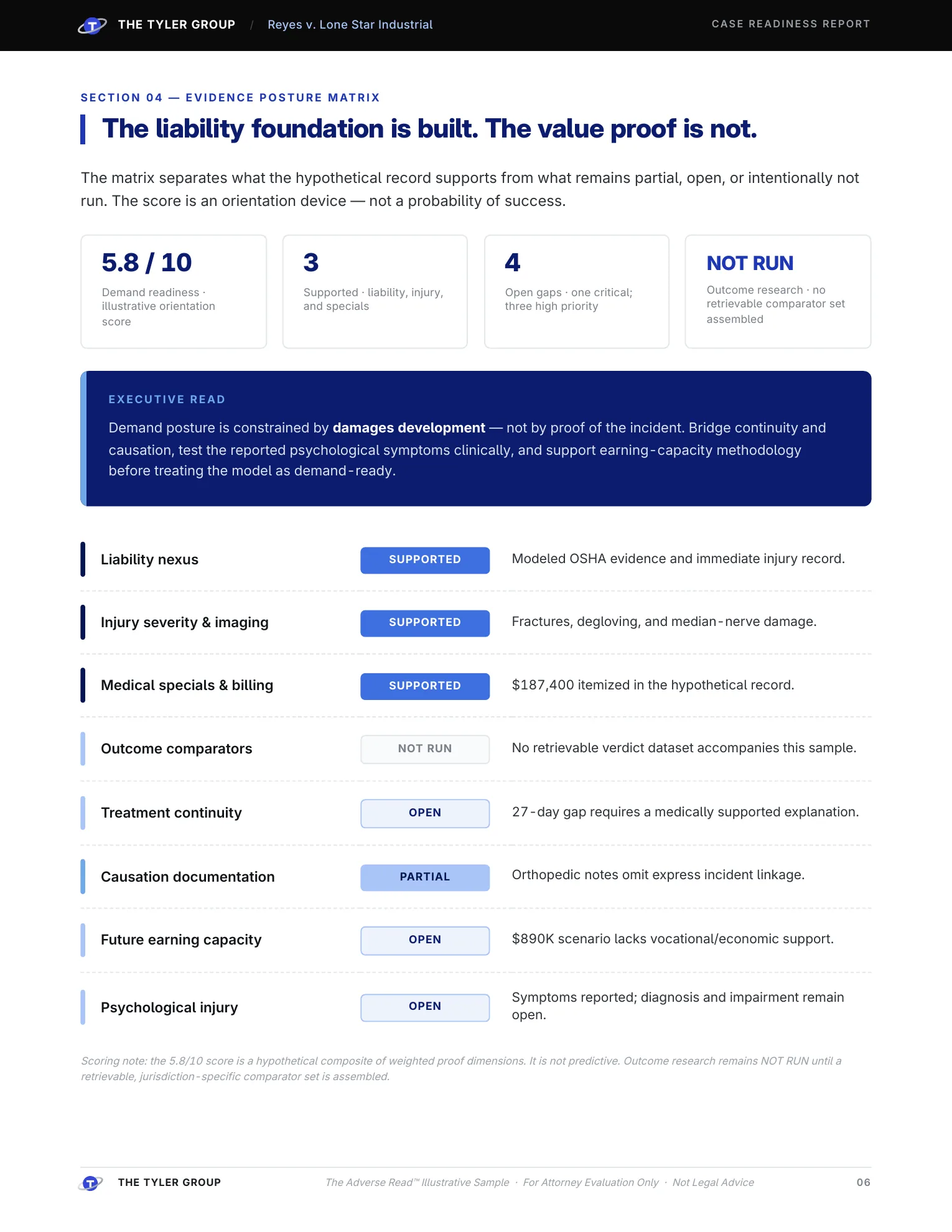
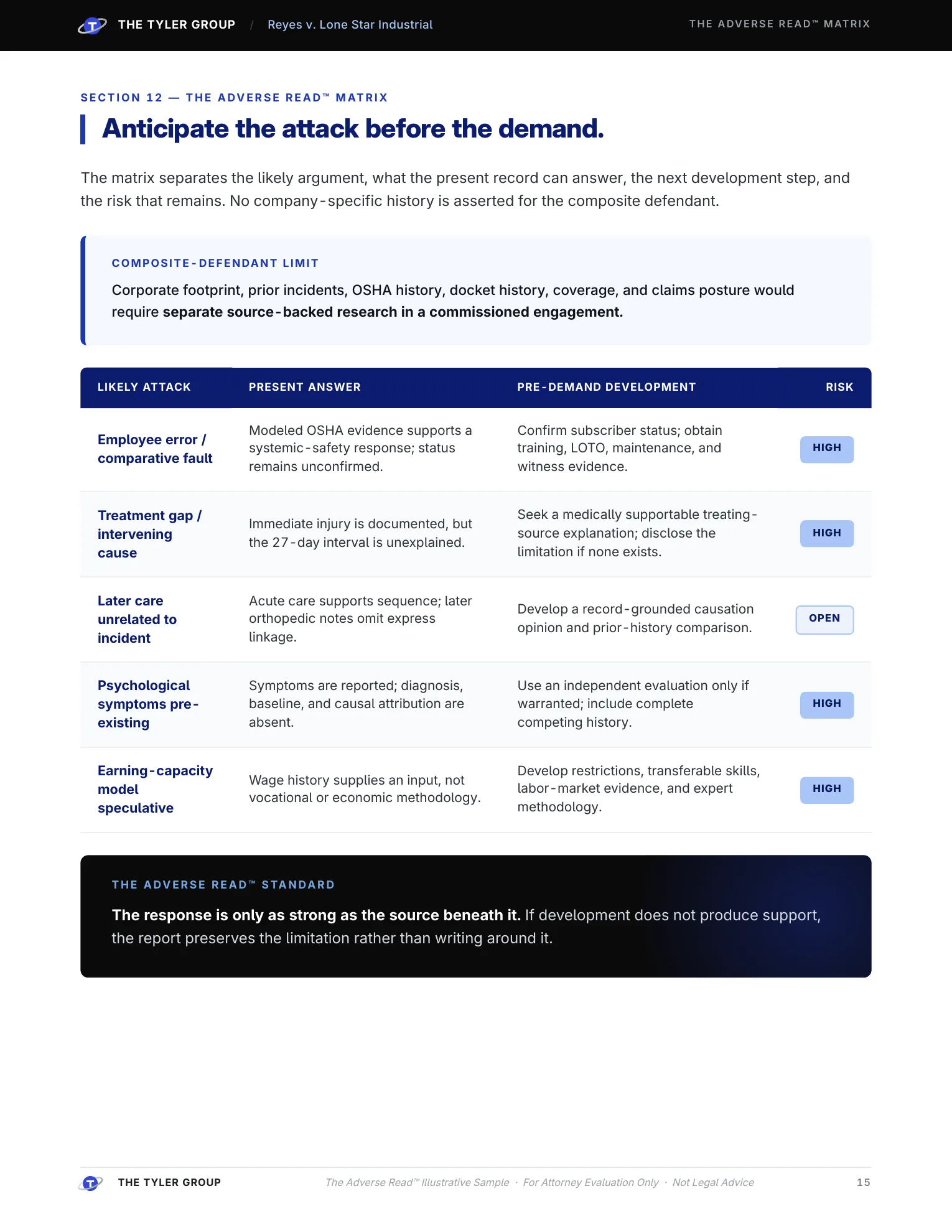
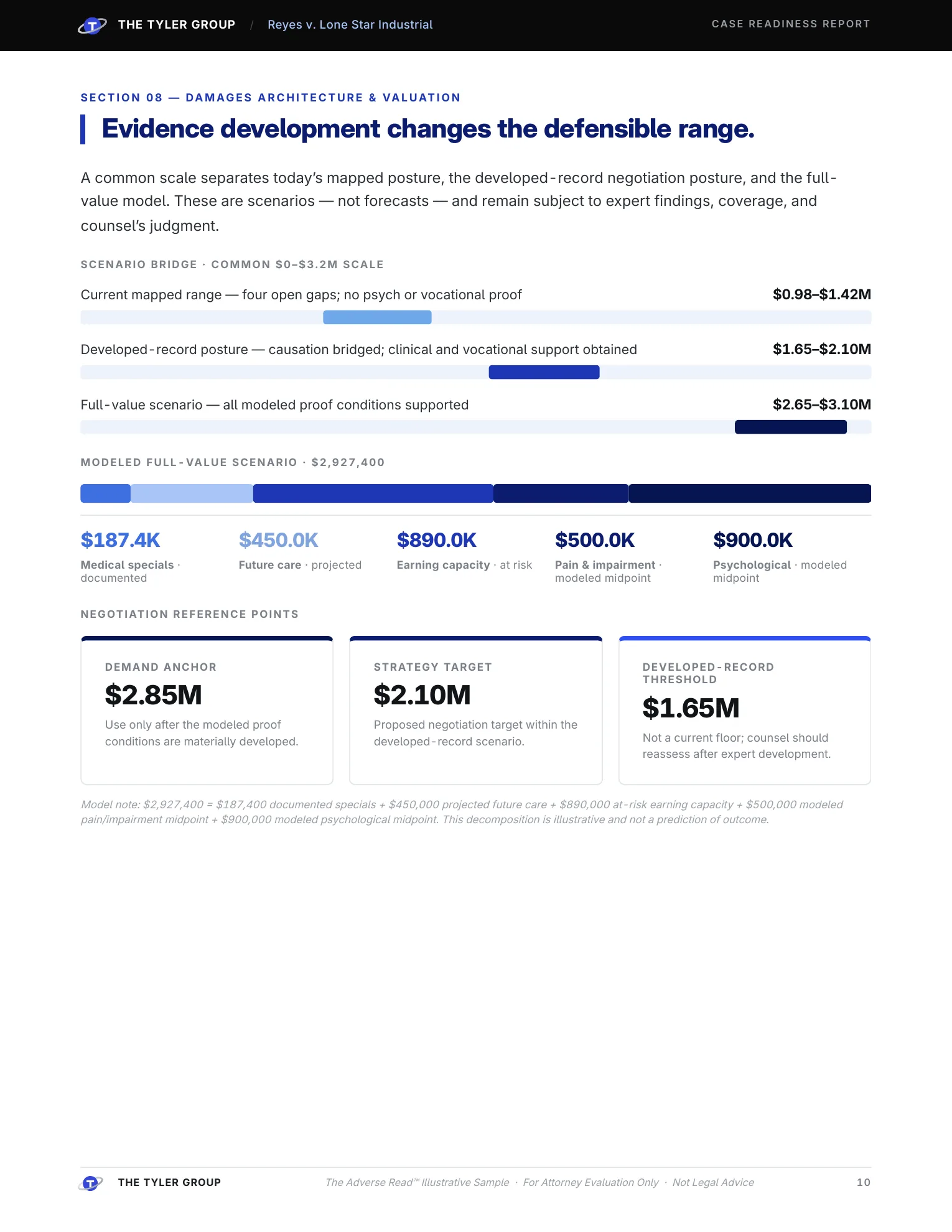
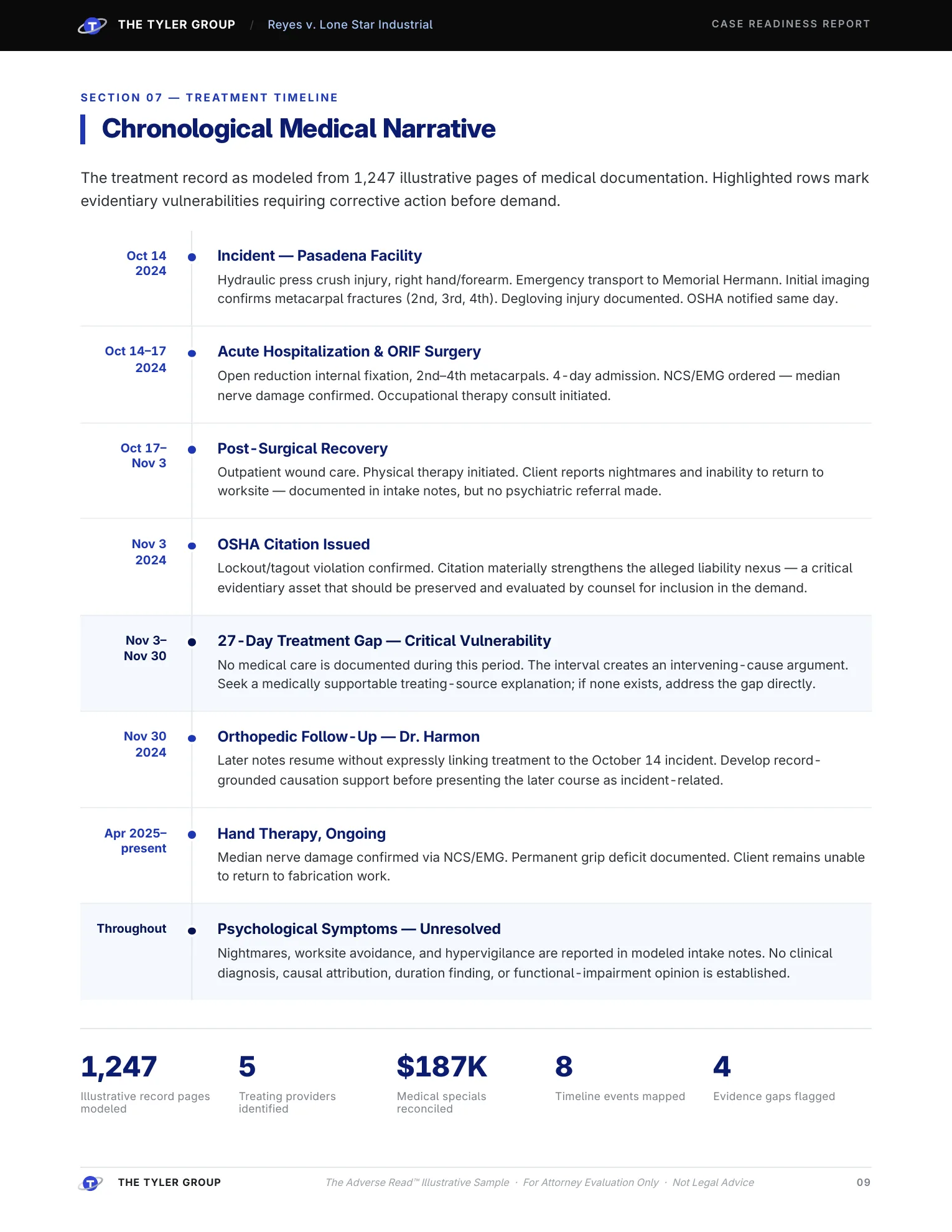
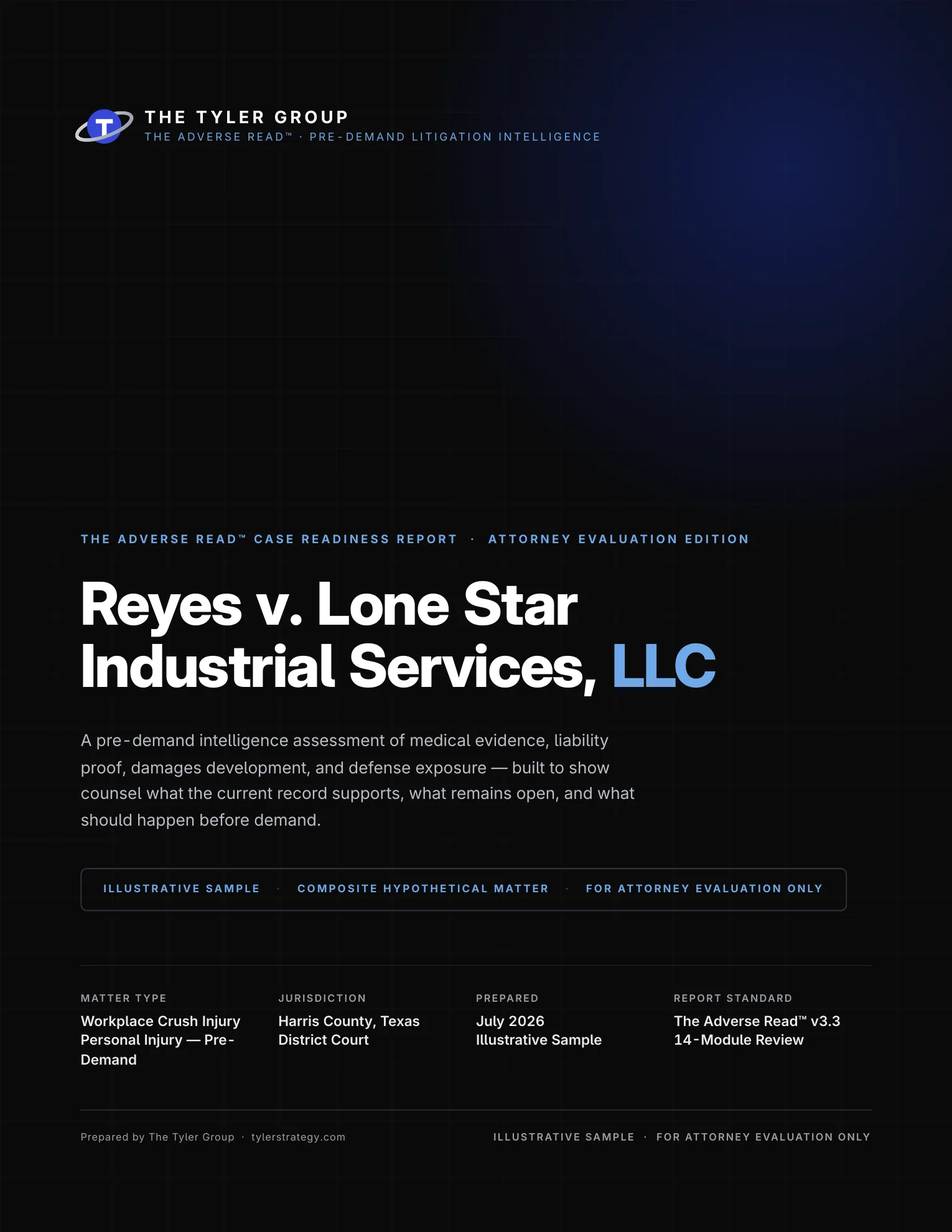
Illustrative work productSelected analysis pages · Composite hypothetical
Select any page to request the report
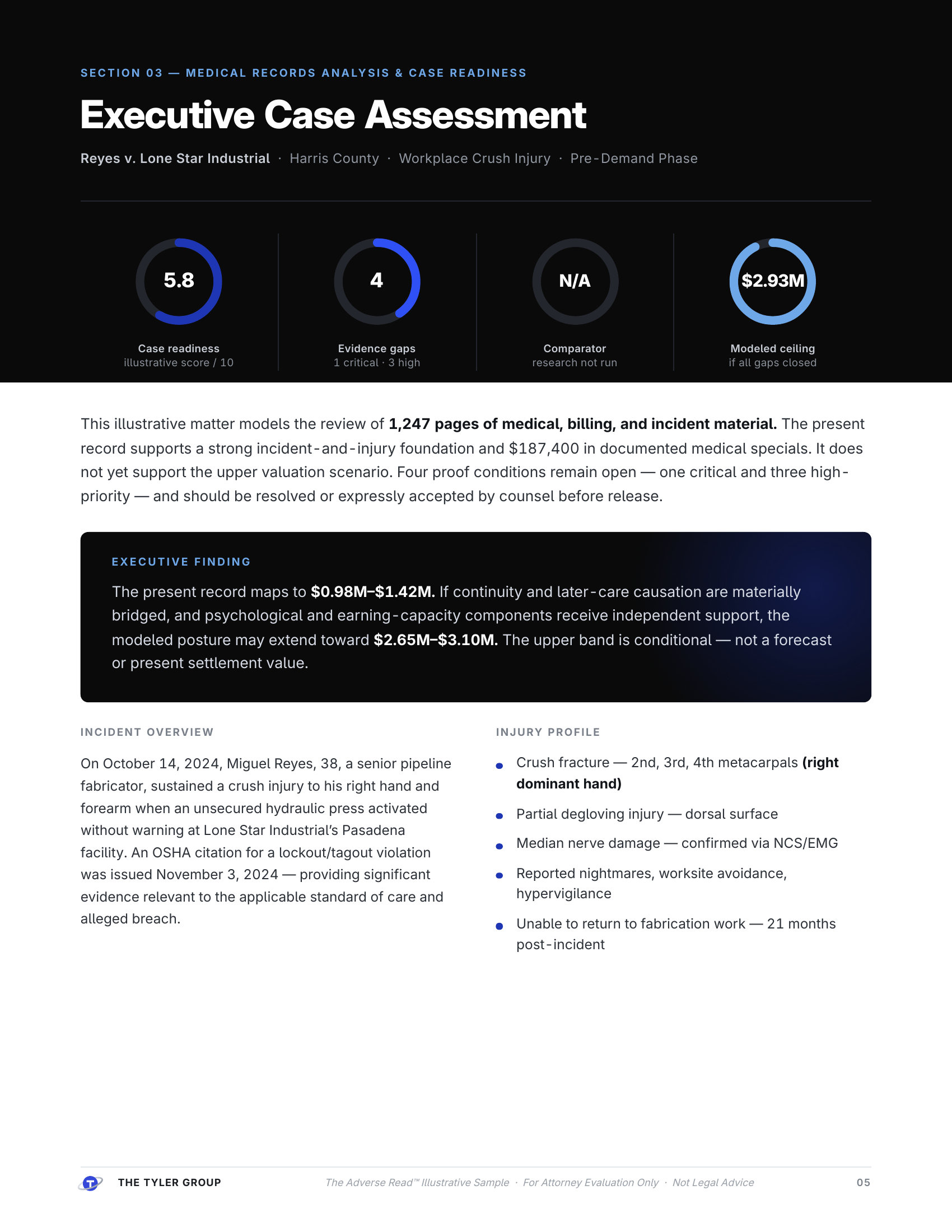
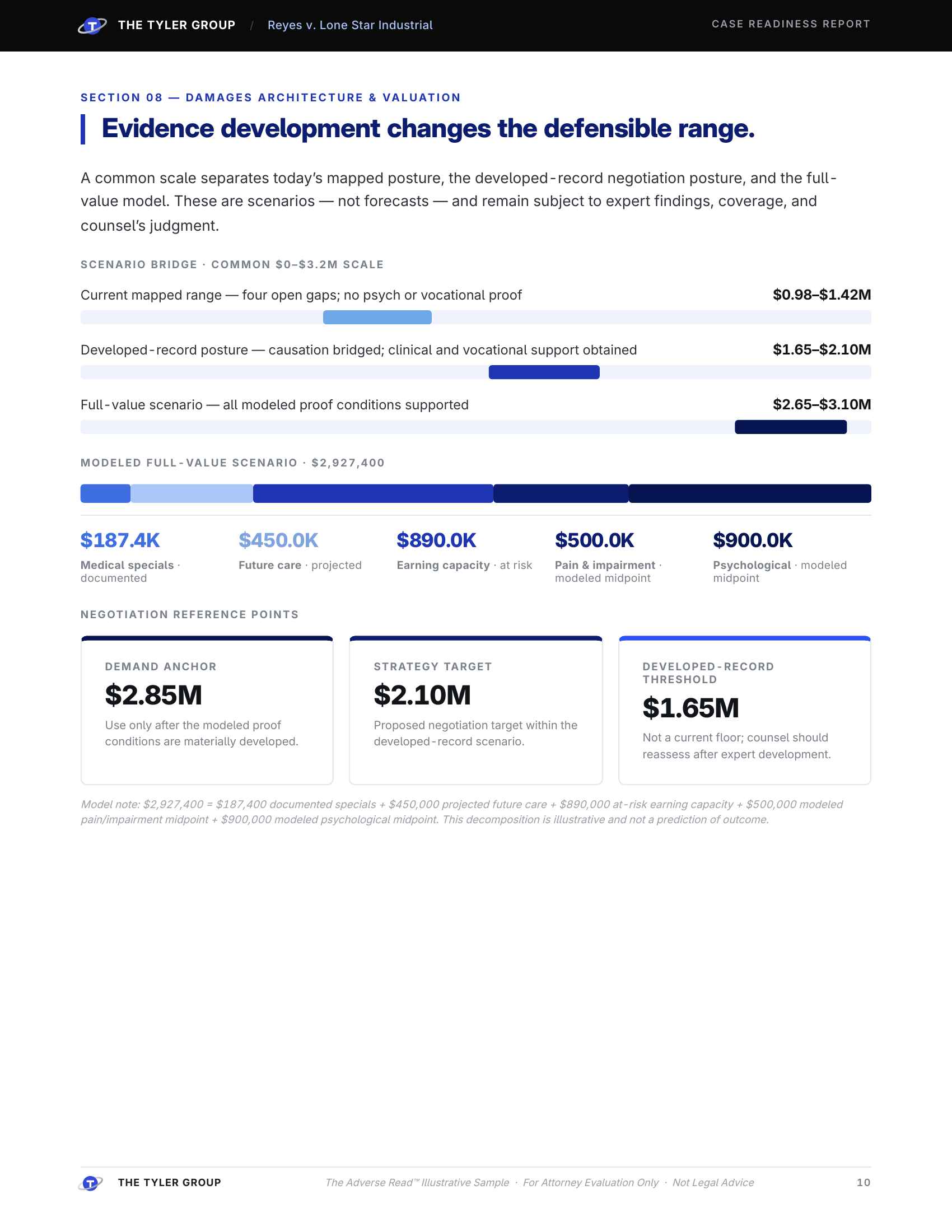
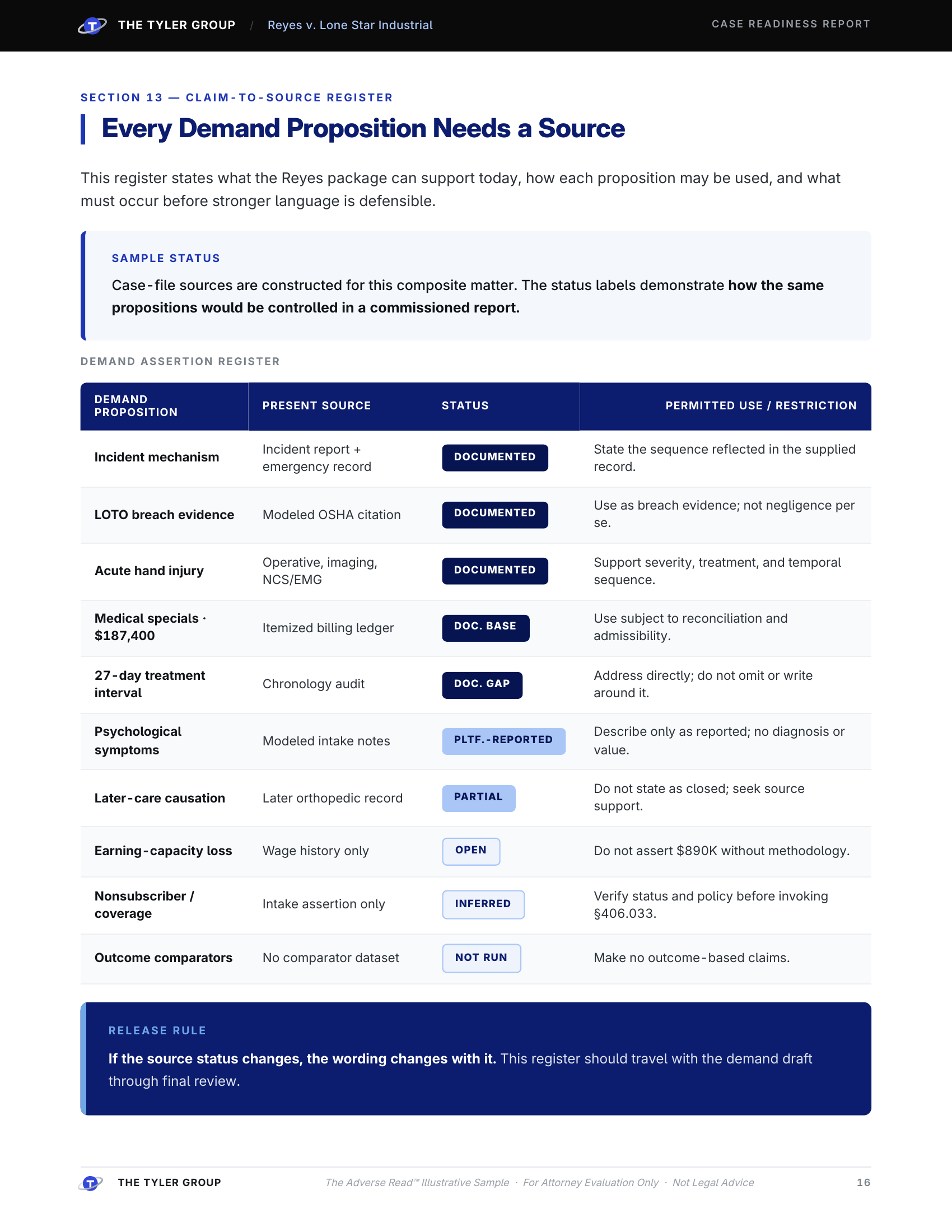
Complete 18-page Adverse Read™ analysis · Composite hypothetical · Delivered by email
Before the position leaves your office.
A completed file creates a moment of decision. The narrative, evidence, and damages position must carry the same argument. An independent review at this point can expose an unsupported inference or unresolved contradiction while counsel still has the opportunity to strengthen the record, adjust the position, or proceed with a clear understanding of the exposure.
A decision document that makes the support, exposure, and choices clear before counsel commits.
Test the account against the record. Trace material claims to their support in the underlying documentation.
Separate documented fact from assertion. What the file can prove today, and what still needs to be built.
Find the evidence gaps before the defense does. Map each gap against the limitations timeline and sequence the corrective actions.
Pressure-test liability, causation, and damages against the credible adverse interpretations of the same evidence.
Model a defensible value range with every assumption visible, then hand you a prioritized action map for the pre-demand window.
Experience.
Under pressure.
Our institutional perspective was developed inside major regulated organizations. Before founding The Tyler Group, our founder spent years in banking leadership at Bank of America and U.S. Bank, alongside operational leadership at Target. Across those roles, he learned firsthand how large institutions assess credibility, scrutinize documentation, and decide when a matter finally forces them to move.
That experience informs a defense-oriented reading of the file: how a position is documented, where its credibility depends on inference, and how organizational incentives shape the response.
That understanding is not only professional. After the loss of his first wife and their daughter to maternity complications, our founder spent three years on the resulting medical-malpractice matter, an asymmetric fight against a powerful institutional adversary.
Working alongside counsel, and drawing on his read of how that institution weighed its own exposure, he learned to read the record the way the other side would — and understood why that discipline matters before any number goes on paper. That experience made him exacting about the record and the interpretations it can sustain under pressure.
The matter ultimately resolved materially above the ceiling counsel had initially believed attainable.
A Certified Six Sigma Green Belt from Villanova University provides the formal discipline. Institutional experience and firsthand adversarial work become a repeatable claim-to-source examination.
Define the position. Examine the sources. Analyze contradictions and failure points. Identify what must change. Verify the work before release. Each material conclusion remains open to counsel’s inspection.
From plaintiff attorneys who worked directly with Ray in resolved matters.
On working relationshipWorking with Ray made this the easiest settlement of my career.
On strategic architectureRay operates with rare architectural acuity in litigation. Every gap the defense had, he had already anticipated and closed. By the time the counteroffer arrived, settlement on our terms was the only viable path. His framework works.
On negotiator caliberRay is a strong negotiator. If he ever chose to practice law, I would hire him.
How we work, and why you can rely on it.
Every engagement is founder-led. The analysis is personally conducted, reviewed, and signed off before delivery. You work directly with the people doing the work. There is no account layer and no hand-off between the person who understands your matter and the person who writes it up.
Founder-led, every file. The person who understands your matter is the person accountable for the output.
Licensed clinician review on psychological-damages components of every applicable engagement.
Every figure is verified or labeled. Either confirmed against the record with its source stated, or identified as a modeled estimate with its basis disclosed.
Every comparable is traceable to its source. Nothing is asserted that cannot be produced on request.
Our firm is designed to be checked. That discipline is the product's entire value proposition.
Research draws from primary court records and established legal, regulatory and litigation-intelligence resources, including FMCSA SAFER, CourtListener, Trellis, Descrybe and VerdictSearch.
You do not have to take any of this on faith.
You have already seen what the report looks like. Submit a matter for a confidential fit review and see what it looks like on your file. Or name a closed matter your team already knows the outcome on — let us run it blind and measure the result. No obligation. No account manager. Direct to the founder.
Know what the file can prove before you decide what to demand.