Decision architecture
Questions, dependencies, and counsel-controlled choices are visible at the point of decision.
Your team and systems prepare the file. The Adverse Read™ independently tests whether it is ready to carry the position counsel intends to take.
Founder-led, source-grounded adverse analysis for consequential plaintiff matters. Texas & North Carolina.
Attorney-only·No sales call required·No case details or PHI needed for the sample
Attorneys, support staff, and the tools you choose.
An independent examination of the underlying record.
The evidence, the exposure, and the decisions remain yours.
The independent stress test between “the file looks ready” and “counsel commits to a position.” A polished narrative can still depend on a missing record, an overstated inference, or a contradiction that changes its meaning.
We examine the record separately from the team that prepared it: what supports the intended position, what cuts against it, and what an adverse reader could credibly make of the same evidence. The review applies whether your file was prepared by people, software, or both.
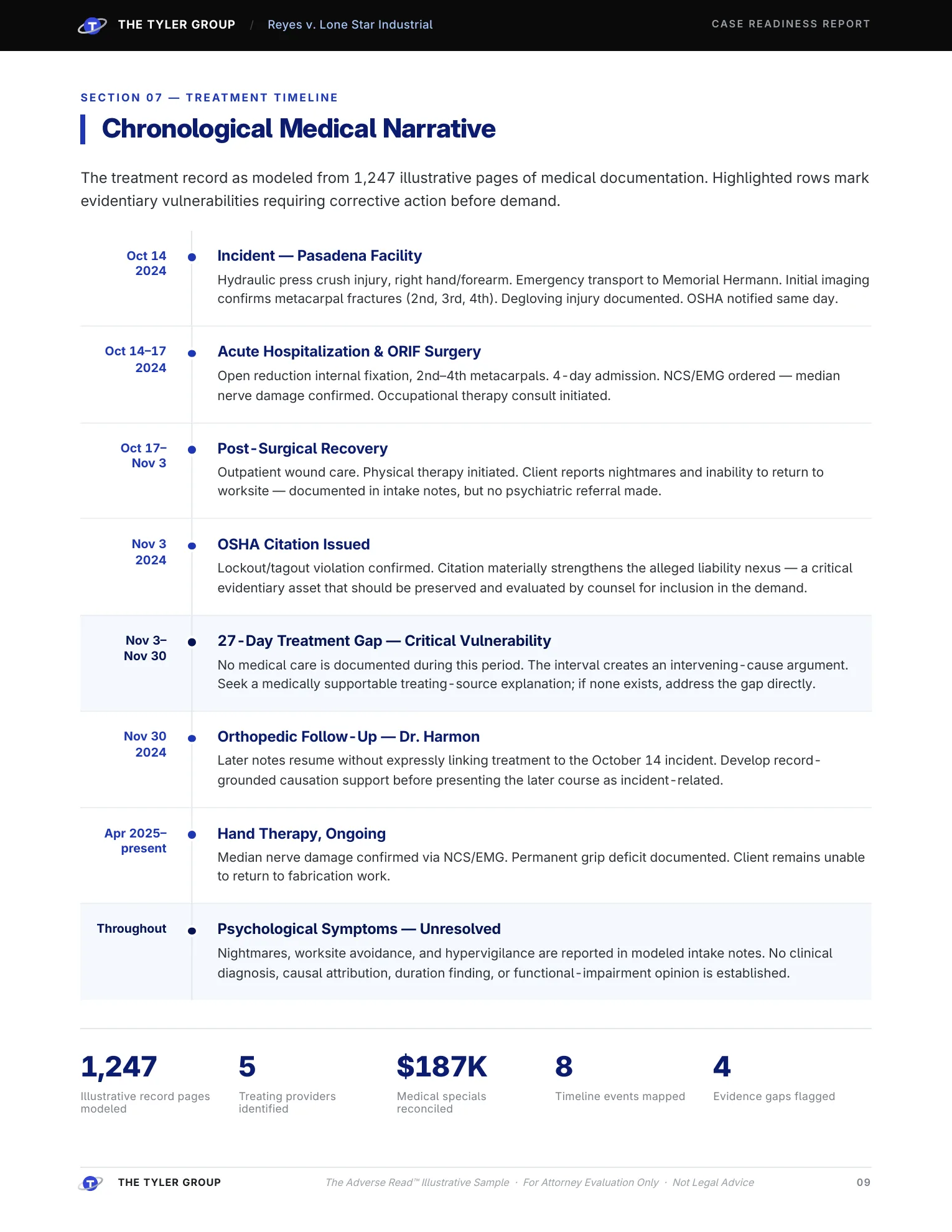
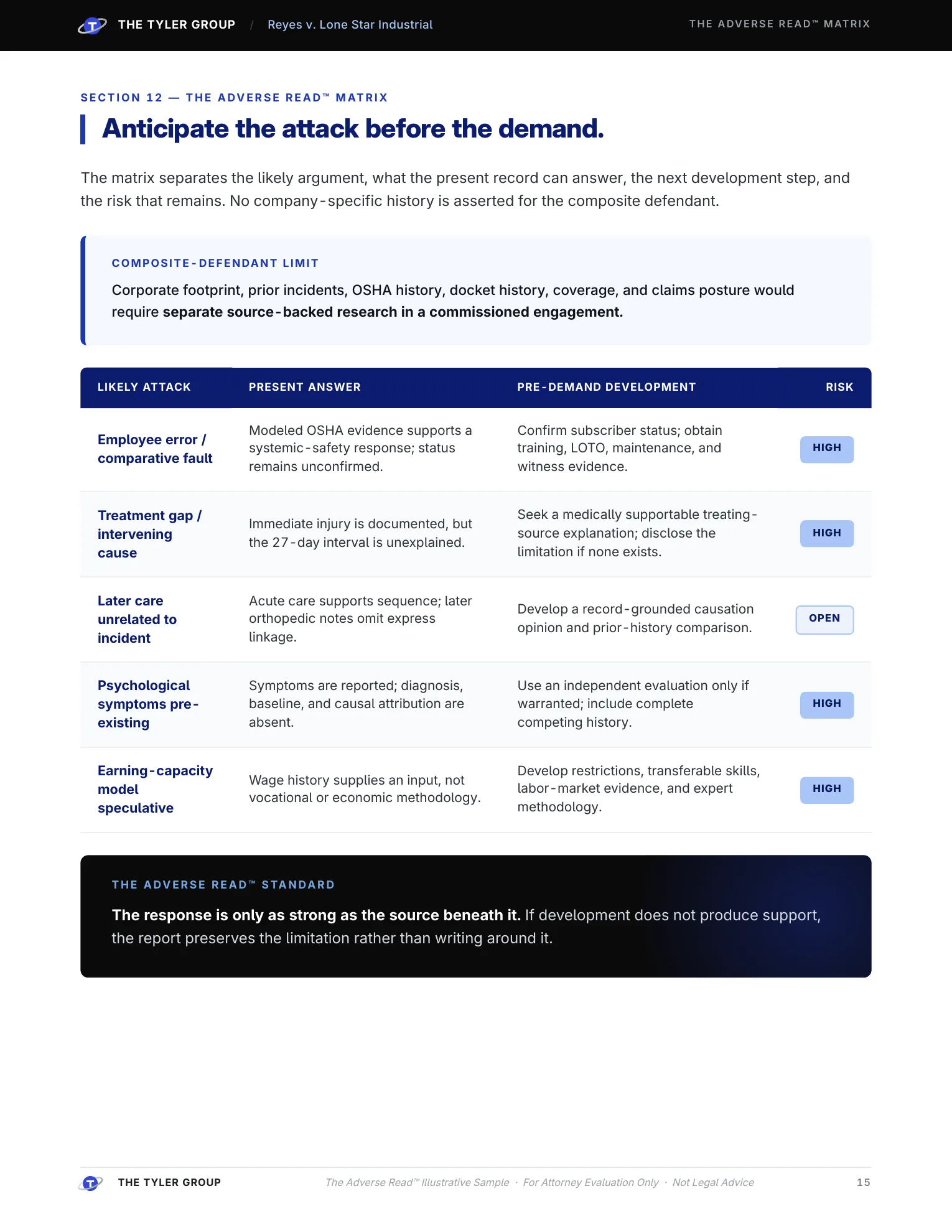
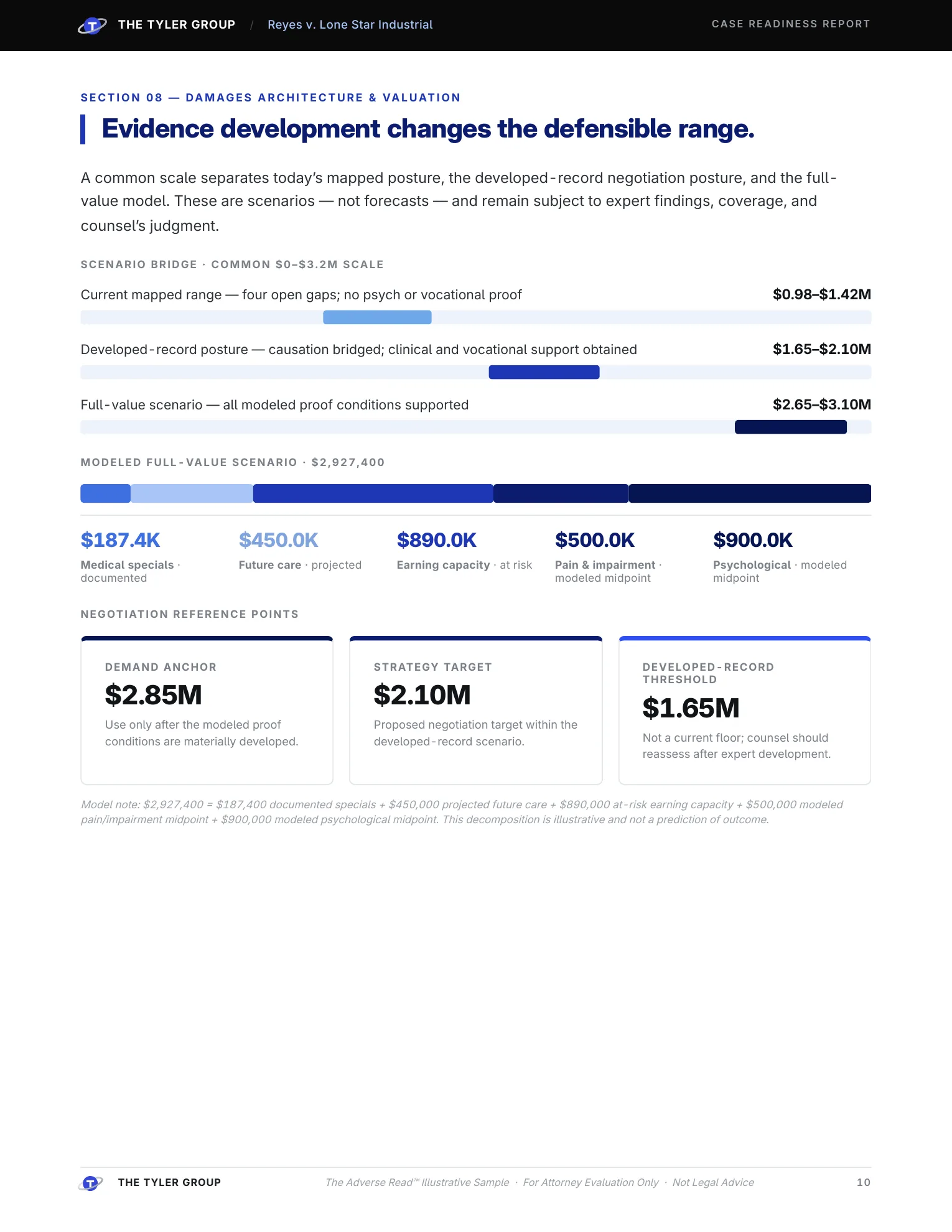
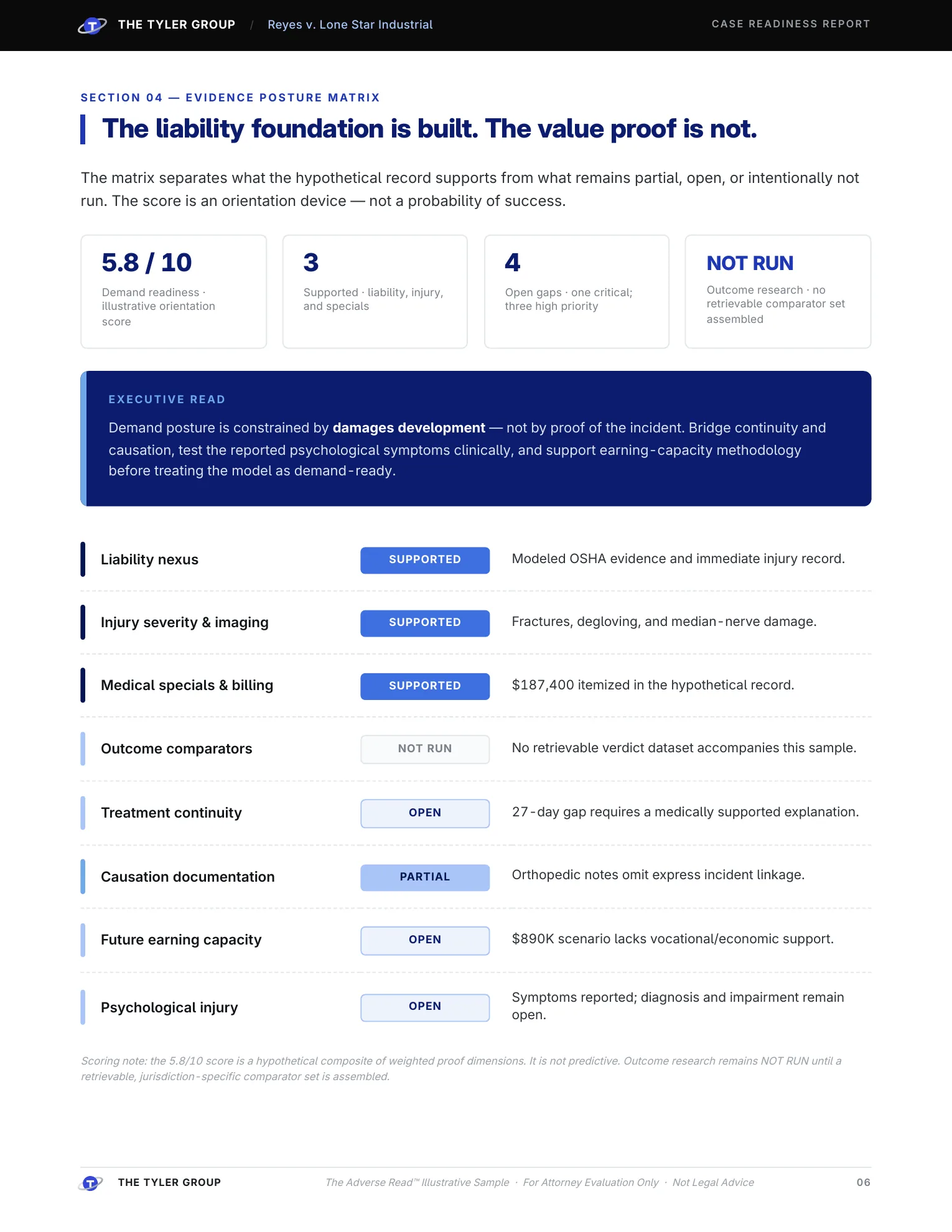
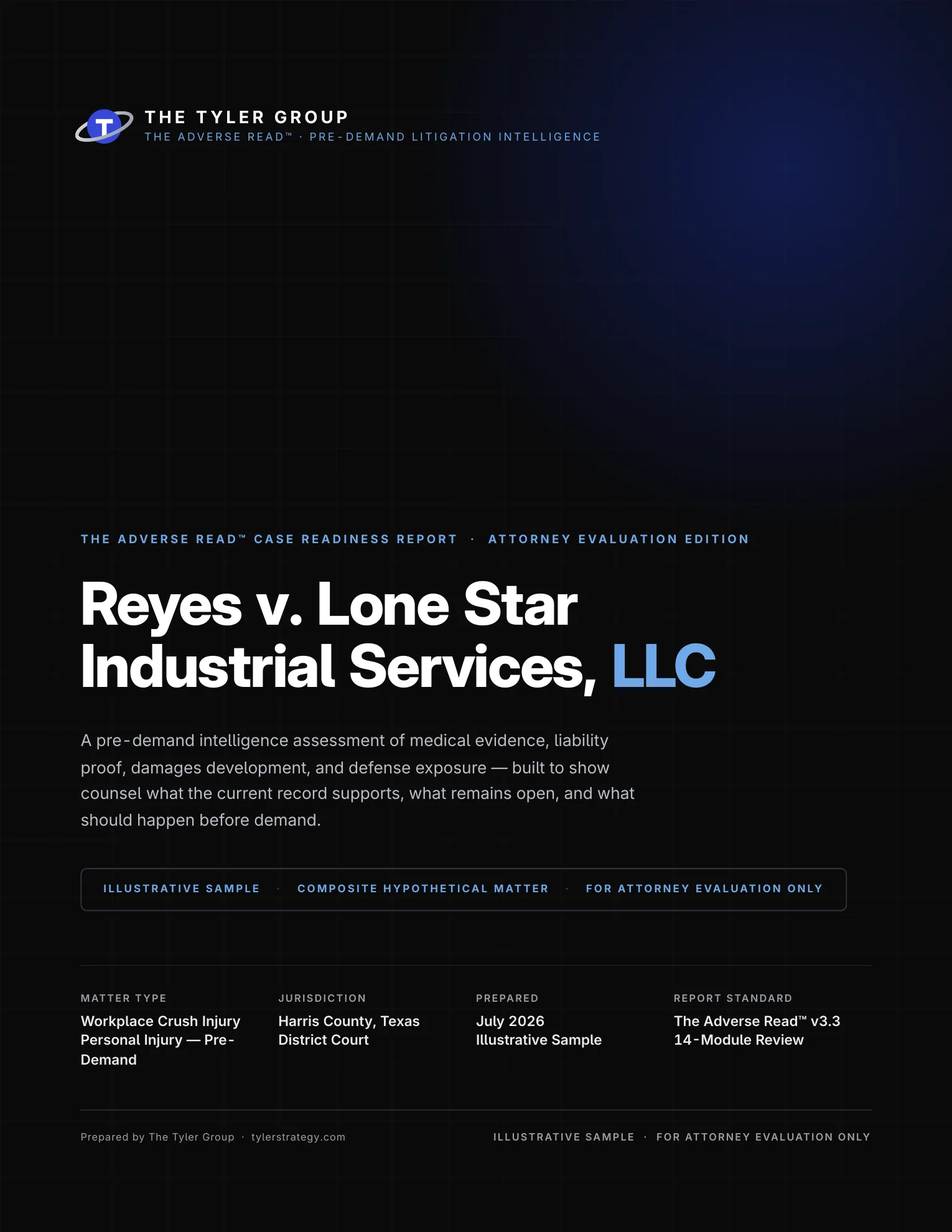
Reyes is an 18-page attorney-evaluation sample built on a fully disclosed composite hypothetical. It shows how The Tyler Group turns a modeled 1,247-page record into counsel-ready decision architecture without presenting constructed facts as client results.
Illustrative sample · Composite hypothetical · No case details required
Questions, dependencies, and counsel-controlled choices are visible at the point of decision.
Verified, reported, inferred, modeled, and unresolved propositions remain visibly distinct.
Proof gaps, damages scenarios, likely defense attacks, and next actions remain connected.
Counsel does not need another summary of the file. Counsel needs a disciplined answer to what the record supports, where it remains vulnerable, and what to do before positions harden.
Each layer answers a decision counsel must make before demand. Every material assertion is classified by evidentiary status, so the boundary between the record and the analysis remains visible on the page.
Every material assertion in the report carries one of six labels. The first four describe how directly the record supports it; the last two are process states — not yet obtained, or reserved for counsel.
Eight core outputs create a consistent analytical spine; the exact report architecture follows the file. Sources, assumptions, gaps, and counsel decisions remain connected throughout.
See the illustrative reportPresentation cannot cure an unsupported claim. The authority of The Adverse Read™ comes from making the boundary between the supplied record, the analytical inference, the modeled estimate, and counsel's decision visible on the page.
Source citations do not make a system independent of its own framing.
Traceability lets counsel check a citation. Independent challenge tests the framing: what was omitted, what was inferred, and what competing interpretation the same record supports.
The Adverse Read™ examines those assumptions before they become your external position.
A VERIFIED assertion is traceable to the supplied record, with source location identified where the file permits. It is never expanded beyond what the underlying material establishes.
An ESTIMATE remains visibly labeled and bounded by its assumptions, source status, and scenario. It may inform counsel's judgment; it is never presented as a verified outcome or guaranteed value.
The Adverse Read™ is an analysis engine. The report is intelligence for use by licensed counsel — not a substitute for attorney judgment. Filing decisions, demand amounts, theory selection, and settlement authority remain entirely with plaintiff's counsel. The analysis informs those decisions. It does not make them.

“Working with Ray made this the easiest settlement of my career.”
Counsel observations on resolved matters
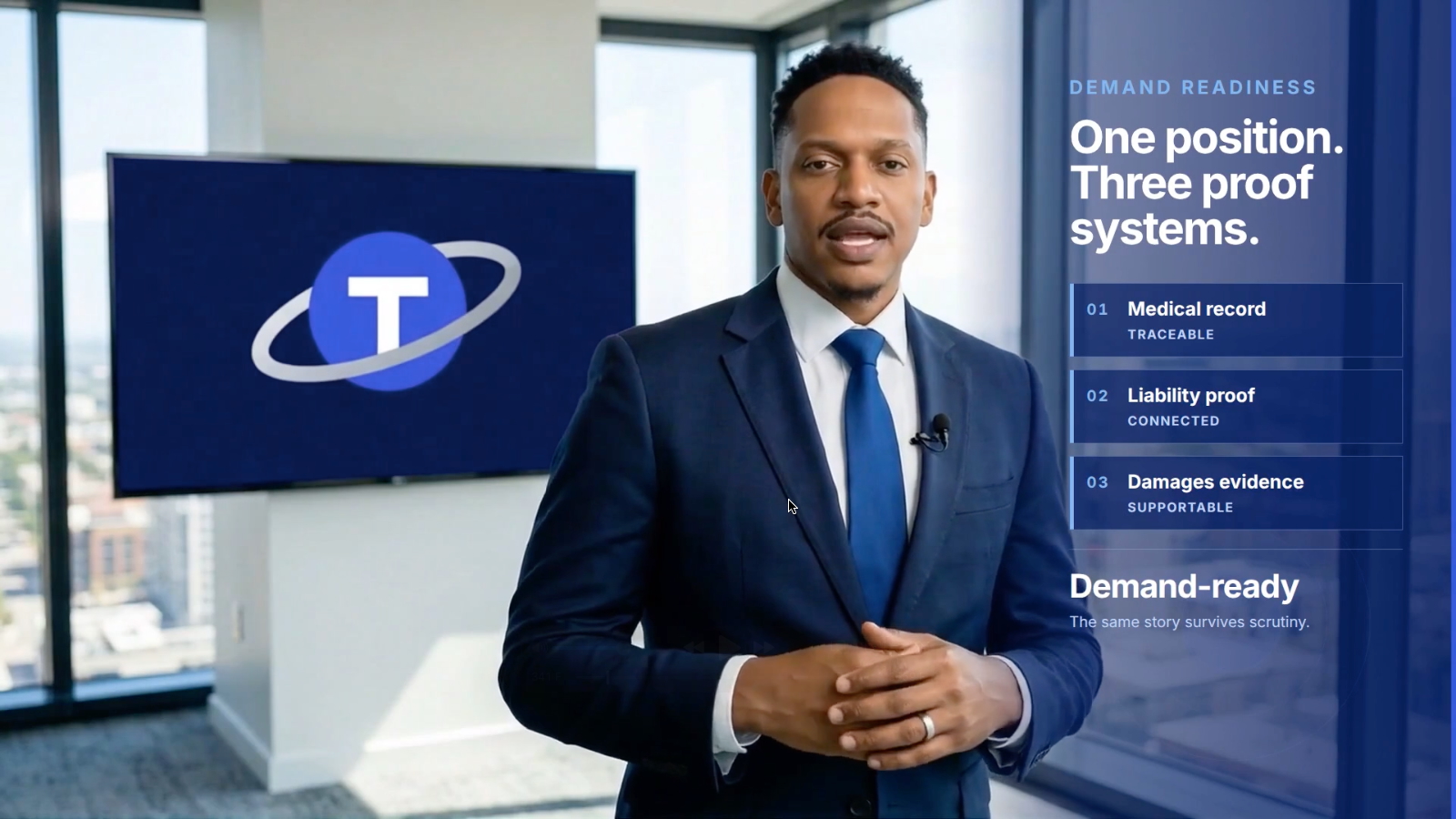 Founder-led, by designMeet the strategist behind every Adverse Read™Watch the 2-minute founder film →
Every report is built for two readers: plaintiff's counsel deciding what to do next, and the defense professional looking for a reason to discount the file.
The Tyler Group formalizes a record-intensive approach to consequential disputes: reconstruct the file, identify where an institution's position and its own evidence diverge, anticipate how decision-makers may respond, and sequence the next move while the record can still be developed.
The Adverse Read™ supplies the analytical discipline; Raymond E. Tyler supplies the accountable judgment. Every commissioned report is built or substantively reviewed by the principal before delivery. Where specialized clinical review is appropriate, it is incorporated under a defined scope by licensed professionals.
Leadership inside Bank of America and U.S. Bank, alongside operating experience at Target. A firsthand view of documentation, risk, organizational incentives, and consequential decisions.
Firsthand work navigating complex disputes involving corporations, institutions, and public bodies. Experience reconstructing records, challenging accounts, and advancing matters toward resolution.
Certified Six Sigma Green Belt, Villanova University. DMAIC discipline applied to a purpose-built claim-to-source methodology: define the proposition, examine the evidence, and test the failure points.
Psychological-damages and functional-impact sections may be reviewed, when in scope, by fully licensed clinicians with 15+ years of experience and licensure in Texas and North Carolina. Additional disciplines are incorporated as the matter requires.
Our delivery goal is 72 hours after the file is accepted as complete; the outside date is set in the engagement agreement and is ordinarily 10 business days. The schedule is confirmed for the matter’s scope and record volume before substantive analysis begins.
The Adverse Read™ is most valuable when documentary complexity, institutional opposition, and potential recovery make a disciplined pre-demand workup economically rational.
A complimentary fit review determines whether the matter justifies full analysis. If it does not, the answer arrives before the firm spends a dollar.
Recurring consequential matters approaching demand or another external commitment.
A repeatable review gate before demands are finalized.
Priority capacity and one standing data-handling framework matter.
Report credits refresh monthly. Final scope, payment terms, handling obligations, and matter-specific exclusions are governed by the executed engagement documents.
Initial screening is separated from substantive intake. No medical records or client-identifying case materials belong in the public form.
Review the data-handling postureFit review and agreement acceptance precede workspace release. Any compliance hold requires explicit release.
Every accepted matter follows the same engagement agreement. Additional handling requirements are resolved before release of the workspace.
Matter-specific storage; directly identifying records are not submitted to public AI services.
Source, working, and retained report copies follow the executed agreement’s deletion schedule, subject to holds and documented service interruptions.
Precision about the boundaries of the work is part of the product, not a footnote.
Your team’s preparation is the starting point. The Adverse Read™ separately tests material assertions, omitted evidence, assumptions, and credible adverse interpretations before counsel commits externally. It works with staff-prepared and technology-assisted files alike.
No. The Adverse Read™ is attorney-directed litigation-support analysis. The Tyler Group is not a law firm and does not make filing, demand, settlement, or litigation decisions.
No report is released as unreviewed machine output. The Adverse Read™ uses structured, AI-assisted synthesis within a controlled workflow. Material assertions are classified, the analysis is challenged, and the principal reviews the final work product.
Medical-record matters proceed only through secure substantive intake under the applicable agreement. Directly identifying records are not submitted to public AI services, and access and deletion controls are defined before transfer.
It demonstrates structure, labeling discipline, analytical depth, and design standard. Reyes is a disclosed composite hypothetical, presented so counsel can inspect the method and work product.
Selectively, yes. A closed file with a known record and outcome lets the firm compare the analysis against its own understanding. Ask about a confidential cold-file evaluation during fit review.
The Adverse Read™ is built for plaintiff attorneys and firms handling consequential matters against insured, corporate, and institutional defendants. The initial profile confirms fit without exposing the underlying client's identity or medical information.
Every Adverse Read™ analysis follows a disciplined, repeatable method — Six Sigma process rigor (DMAIC), adapted to pre-litigation analysis.
Provide only the matter type, current posture, broad value band, and what counsel wants assessed. Do not include names, medical facts, records, or other confidential narrative in the public form.
If the matter is a fit, you'll receive the next step. If not, you'll know before committing to a paid analysis.
Initial submissions are handled as confidential litigation-support material. Counsel determines privilege and work-product treatment.